
Most hair care advice is written for people who deal with dry cold winters and moderate summers. If you live in Trinidad and Tobago, that advice doesn’t fully apply to you. Your hair operates under different conditions — year-round humidity above 80%, heat that keeps your scalp producing sweat and oil from morning to night, UV exposure that degrades hair proteins, and for many people, textured or curly hair that has its own structural needs.
These aren’t minor details. They change which products work, how often you should wash, what your scalp needs, and why your hair might be thinning, frizzing, or breaking despite doing “everything right.”
This guide covers the hair care essentials that actually matter in a tropical Caribbean climate, what each product does, why it matters here specifically, and how to build a routine that works with your environment rather than against it.
What Trinidad’s Climate Does to Your Hair and Scalp?
Before choosing products, it helps to understand what’s actually happening to your hair in this climate. The problems you see on the surface, frizz, oiliness, thinning, breakage, usually start at the scalp.
Humidity and Frizz
Hair is made of keratin, a protein held together by hydrogen bonds. When humidity is high, moisture from the air binds to these proteins and causes the hair shaft to swell. This lifts the outer cuticle layer — the protective shingle-like coating on each strand — making hair rough, puffy, and frizzy.
In Trinidad, where humidity regularly exceeds 80%, this isn’t an occasional bad hair day. It’s the default state of your hair unless you actively manage moisture balance.
Curly and textured hair is especially affected because the cuticle layer is already more raised on curled strands, making them more porous and more reactive to humidity.
Sweat, Oil, and Scalp Build-Up
Heat triggers two things simultaneously: your sweat glands produce more moisture, and your sebaceous glands produce more oil (sebum). In a tropical climate, this happens constantly — not just during exercise or midday heat.
When sweat and excess sebum accumulate on the scalp, they mix with dead skin cells and environmental debris to form build-up. This build-up can clog hair follicles, restrict healthy growth, and create an environment where fungal organisms like Malassezia thrive. Malassezia is a common cause of dandruff and itchy scalp, and it proliferates in warm, moist conditions — exactly the conditions Trinidad provides year-round.
The chain reaction looks like this: humidity and heat → excess sweat and oil → scalp build-up → follicle inflammation → weakened hair roots → increased shedding.
If you’ve noticed more hair fall than usual and can’t figure out why, your scalp environment is the first place to look.
UV Damage to Hair
Just as UV radiation damages skin, it damages hair. Prolonged sun exposure breaks down the protein structure of the hair shaft, weakens the cuticle, and causes dryness, brittleness, and colour fading. In Trinidad, where the UV index regularly reaches 12 to 15 (classified as extreme), your hair receives significant UV exposure every day — even when you’re not on the beach.
The Four Essentials: Oil, Shampoo, Conditioner, Serum
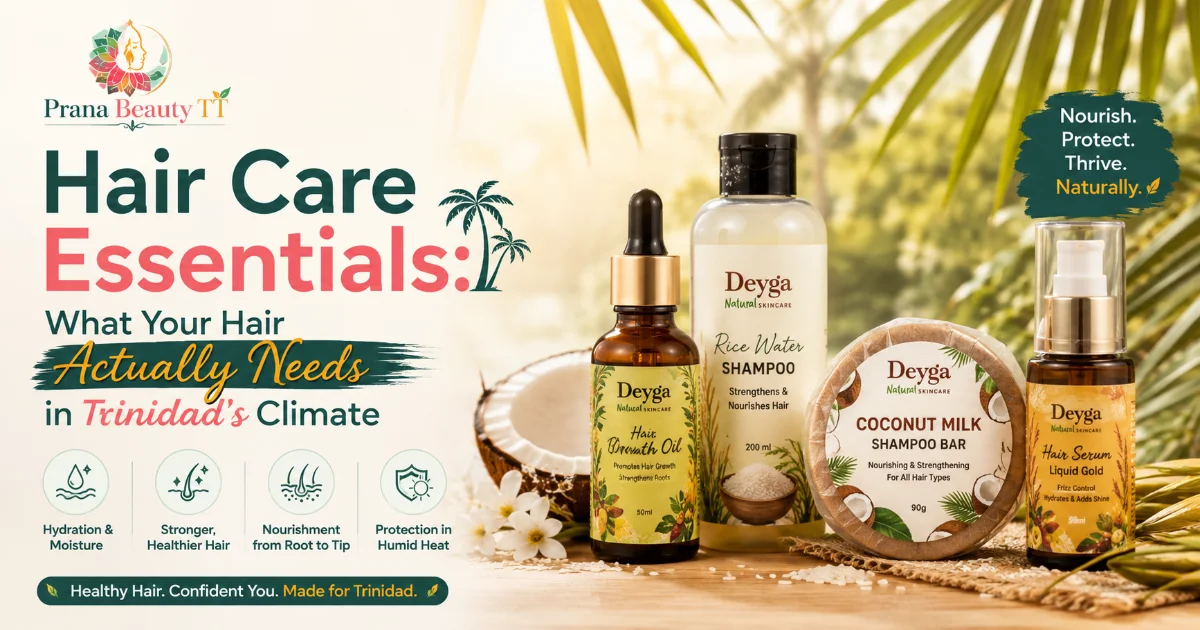
A complete hair care routine in a tropical climate doesn’t need to be complicated, but it does need to address four things: scalp nourishment, proper cleansing, moisture replenishment, and strand protection. Each essential handles one of these jobs.
1. Hair Oil — Nourishing the Scalp and Strengthening Roots
Oil treatment is the foundation of hair care in warm climates, not because it’s traditional, but because it directly addresses the scalp health problems that humidity creates.
A well-formulated hair oil delivers nutrients directly to the scalp and hair follicles, improves blood circulation through massage, and creates a protective layer that helps strengthen hair from the root. The key is choosing an oil that nourishes without being so heavy that it adds to scalp congestion.
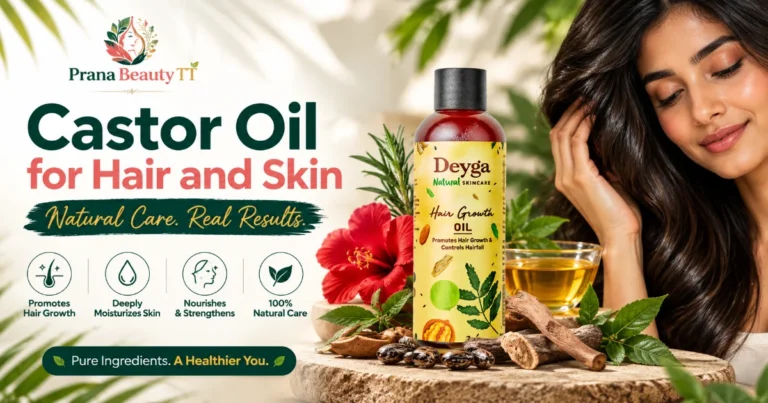
Prana Beauty TT’s Hair Growth Oil combines coconut oil, castor oil, and grapeseed oil with fenugreek, curry leaves, false daisy (bhringraj), and rosemary essential oil. Each ingredient has a specific role:
Coconut oil penetrates the hair shaft more effectively than most other oils because of its low molecular weight and straight-chain structure. Research published in the Journal of Cosmetic Science found that coconut oil was the only oil tested (against sunflower and mineral oil) that significantly reduced protein loss in both damaged and undamaged hair.
Castor oil is high in ricinoleic acid, which has anti-inflammatory properties that can help soothe an irritated, overworked scalp — exactly the kind of scalp that develops in humid conditions.
Bhringraj (false daisy) has been used in Ayurvedic hair care for centuries and has shown potential in studies for supporting hair growth by extending the active growth phase (anagen phase) of the hair cycle.
Rosemary essential oil has been compared to minoxidil (a common hair growth treatment) in clinical research, with some studies showing comparable results in promoting hair growth over six months of use.
How to use it in Trinidad’s climate: Apply the oil to your scalp 1-2 hours before washing, or overnight if your hair tolerates it. Massage gently for 5-10 minutes to stimulate blood circulation. In hot weather, you don’t need to warm the oil — it will absorb at room temperature. Wash it out thoroughly with shampoo to prevent residual oil from mixing with sweat during the day.
2. Shampoo — Cleaning Without Stripping
In a tropical climate, proper shampooing is more important than in cooler environments because your scalp accumulates build-up faster. But there’s a balance: you need a shampoo that removes sweat, oil, and debris without stripping so aggressively that it triggers rebound oil production.
Sulphate-heavy shampoos (containing sodium lauryl sulphate or sodium laureth sulphate) are effective cleansers, but they can be too harsh for frequent use — and in Trinidad, you may be washing your hair 3-4 times a week or more. Stripping all the natural oil from your scalp signals your sebaceous glands to produce even more, creating a cycle of greasiness followed by over-cleansing.
Prana Beauty TT offers two shampoo options that take different approaches:
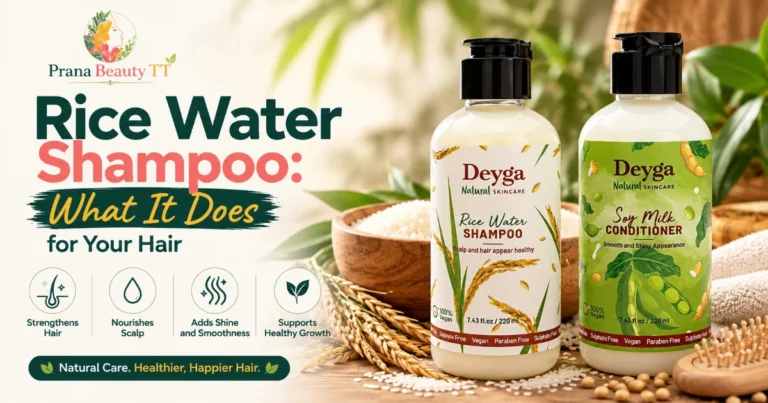
The Rice Water Shampoo uses fermented rice water as its base — an ingredient with a long history in Asian hair care. Fermented rice water contains inositol, a carbohydrate that can penetrate damaged hair and repair it from within, reducing breakage. It also contains amino acids that help strengthen the hair shaft. It’s sulphate-free, which makes it suitable for frequent washing without excessive stripping.
The Coconut Milk Shampoo Bar is a solid shampoo option that combines coconut milk’s fatty acids with gentle cleansing agents. A shampoo bar can be practical in Trinidad’s climate — it doesn’t require a plastic bottle, travels easily, and tends to last longer than liquid shampoo. Just make sure to let it dry between uses, as humidity can soften solid bars faster.
How often to wash in tropical heat: Most people in Trinidad do well washing 2-3 times per week. If you exercise daily or your scalp gets visibly oily, you might wash more frequently — but consider alternating between a full shampoo wash and a water-only rinse to avoid over-cleansing.
3. Conditioner — Replenishing Moisture After Cleansing
Shampooing opens the hair cuticle to remove dirt and oil. Conditioner closes it back down, smoothing the cuticle layer and locking in moisture. Skipping conditioner — especially in a humid climate — leaves the cuticle open, which makes hair more porous, more reactive to humidity, and more prone to frizz and tangling.
Prana Beauty TT’s Soy Milk Conditioner is a lightweight, plant-based formula that hydrates without weighing hair down. This matters in Trinidad’s climate because heavy conditioners can sit on fine or straight hair, making it look flat and greasy in the humidity. Soy protein helps strengthen the hair shaft while the conditioner smooths the cuticle.
Application tip for humid climates: Apply conditioner from mid-length to ends only — not the scalp. Your scalp is already producing enough oil in this climate; adding conditioner to the roots can accelerate greasiness. Leave it on for 2-3 minutes, then rinse thoroughly with cool or lukewarm water. Cool water helps close the cuticle further, reducing frizz when you step into the humid air.
4. Hair Serum — Protecting Strands from Heat and Humidity
A hair serum is a leave-in treatment that creates a protective barrier on the hair shaft. In a tropical climate, this barrier serves two purposes: it prevents excess moisture from the air from penetrating and swelling the cuticle (reducing frizz), and it adds shine and smoothness by sealing the cuticle layer flat.
Prana Beauty TT’s Hair Serum (Liquid Gold) is a lightweight serum designed to add nourishment and shine without heaviness. It’s applied to damp or dry hair after washing — a few drops massaged from mid-length to tips.
In Trinidad’s humidity, serum is not optional — it’s functional. Without a sealing layer, your freshly washed, smooth hair will begin absorbing ambient moisture within minutes of stepping outside, and frizz sets in. A light serum creates a barrier that keeps your style intact longer and protects the hair shaft from environmental stress.
Building Your Routine: A Practical Weekly Schedule
Here’s how these four essentials fit together in a typical week in Trinidad:
Wash days (2-3 times per week):
Pre-wash: Apply Hair Growth Oil to scalp, massage for 5-10 minutes, leave for 1-2 hours or overnight.
Wash: Shampoo with Rice Water Shampoo — lather at the scalp, let the suds run down the length. Rinse thoroughly.
Condition: Apply Soy Milk Conditioner from mid-length to ends. Leave 2-3 minutes. Rinse with cool water.
Protect: Apply 2-3 drops of Hair Serum (Liquid Gold) to damp hair, focusing on ends and frizz-prone areas.
Non-wash days:
If hair feels dry or frizzy, apply a small amount of serum to smooth and protect. Avoid touching hair excessively — hands transfer oil and sweat to strands.
Weekly deep treatment (optional but beneficial):
Once a week, leave the Hair Growth Oil on overnight with a light head wrap. Wash out in the morning. This gives the oils and botanical extracts more time to absorb into the scalp and work on follicle nourishment.
Common Hair Problems in Trinidad — And What’s Actually Causing Them
“My hair falls out more than it should”
In most cases, increased hair fall in tropical climates traces back to scalp health, not hair health. The humidity → sweat → build-up → inflammation → weakened roots cycle is the most common culprit. Regular scalp oiling and proper cleansing (without over-washing) address the root cause. If hair fall persists beyond 8-12 weeks of consistent care, consult a dermatologist to rule out other factors.
“My hair is always frizzy no matter what I do”
Frizz in humidity is a physics problem — moisture in the air disrupts hydrogen bonds in the hair. You can’t prevent ambient moisture entirely, but you can manage it by keeping the cuticle sealed. Conditioner after every wash and serum before going outside are the two most effective defences. Avoid towel-drying aggressively — blot gently or use a microfibre towel to reduce cuticle disruption.
“My scalp is itchy and flaky”
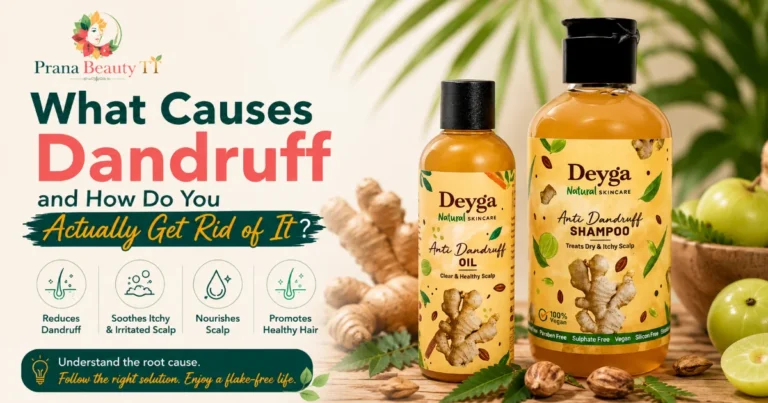
In Trinidad’s warm, humid environment, dandruff is more likely caused by fungal overgrowth (Malassezia) than by dry scalp. The treatment approach is different: dry scalp needs moisture, fungal dandruff needs proper cleansing and sometimes targeted anti-fungal ingredients. Prana Beauty TT’s Anti Dandruff Shampoo is formulated specifically for this concern — it’s worth switching to if regular shampoo isn’t resolving the issue.
“My hair looks flat and oily within hours of washing”
You may be over-conditioning at the roots, not rinsing shampoo thoroughly enough, or using products that are too heavy for your hair type in this climate. Switch to lighter formulations, condition only mid-length and below, and make sure you’re rinsing completely. In tropical humidity, lightweight products outperform rich, heavy ones for most hair types.
Frequently Asked Questions
How often should I oil my hair in Trinidad’s heat?
Once or twice a week is sufficient for most people. Apply oil before washing, not as a leave-in during the day — leaving oil on your scalp in hot weather can mix with sweat and accelerate build-up.
Does humidity cause hair loss?
Not directly, but the chain reaction it triggers — excess oil, scalp build-up, follicle inflammation — can weaken hair roots over time and increase shedding. Consistent scalp care breaks this cycle.
Should I wash my hair every day in tropical heat?
For most hair types, daily washing is too frequent and can strip natural oils, triggering rebound oiliness. 2-3 washes per week is a better baseline. If you need to refresh between washes, rinse with water only or use a light serum to manage.
Is a shampoo bar as effective as liquid shampoo?
Yes, when properly formulated. A shampoo bar cleanses the same way — through surfactants that lift oil and dirt. The only practical difference in Trinidad’s climate is storage: let the bar dry fully between uses to prevent it softening in the humidity.
Can I use coconut oil alone instead of a hair growth oil?
Coconut oil is beneficial for reducing protein loss and adding moisture, but a formulated hair growth oil combines multiple active ingredients — like bhringraj, rosemary, and castor oil — that target different aspects of hair health (circulation, inflammation, follicle nourishment). You get more targeted results from a blended formula than from a single oil.
What’s the best hairstyle for managing frizz in humidity?
Loose styles that don’t pull on roots — braids, loose buns, or simply leaving hair down with serum applied. Tight hairstyles create tension on follicles and can contribute to traction-related hair loss over time. Whatever style you choose, sealing the cuticle with conditioner and serum before styling makes the biggest difference.
The Bottom Line
Hair care in Trinidad and Tobago isn’t about following a generic 10-step routine from a beauty magazine. It’s about understanding what constant humidity, heat, and UV exposure do to your scalp and strands, then using products that address those specific challenges.
The four essentials — oil for scalp nourishment, shampoo for proper cleansing, conditioner for moisture, serum for protection — cover the full cycle. Get those right, stay consistent, and your hair will respond.
Your climate isn’t working against you. You just need a routine that’s built for it.