
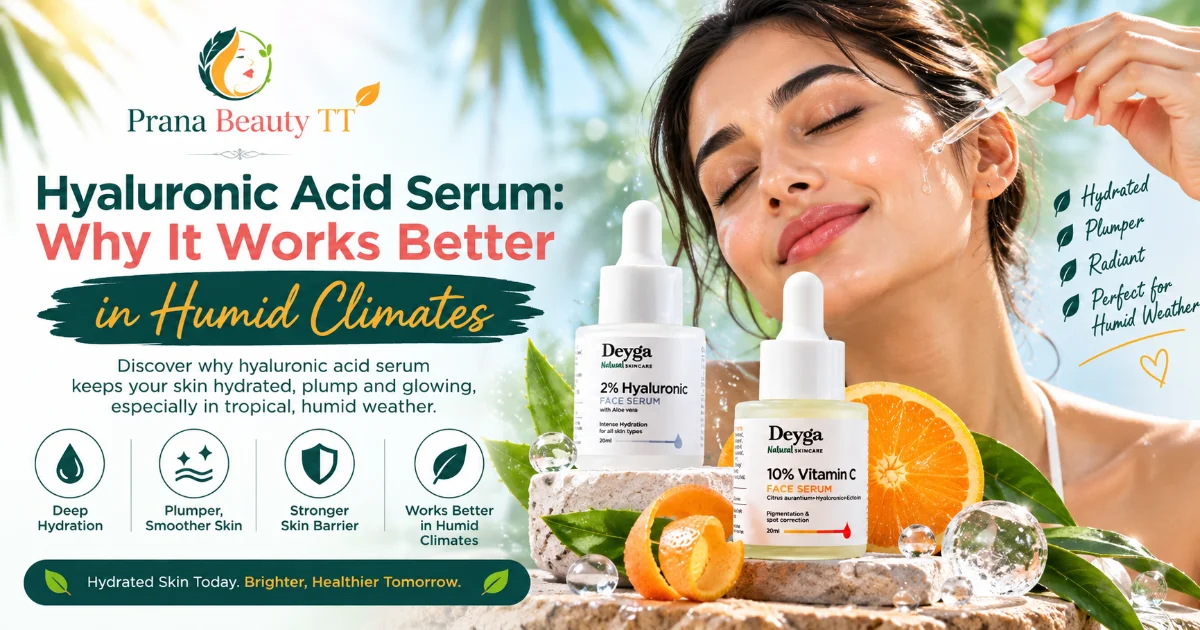
Most skincare ingredients come with caveats about climate. Hyaluronic acid is one of the few that actually performs better in tropical humidity. If you live in Trinidad and Tobago, you have an environmental advantage that most HA articles, written for temperate climates, never mention.
This guide explains how hyaluronic acid works at the skin level, why Trinidad’s humidity makes it more effective rather than less, and how to use it correctly across different ages and skin types.
What Hyaluronic Acid Is and How It Works?
Hyaluronic acid (HA) is a glycosaminoglycan, a molecule naturally produced by your body. It’s found in the skin, eyes, and joints. In the skin, HA exists throughout the epidermis and dermis, where it maintains hydration, structural integrity, and cellular communication.
The defining property of HA is its water-binding capacity. A single gram can hold up to 1,000 times its weight in water. This makes it one of the most effective humectants available in skincare.
Humectants work by drawing water molecules to themselves. When applied topically, HA pulls moisture from two sources: the environment (ambient humidity) and the deeper dermis. It then holds that moisture in the upper layers of the skin, creating hydration that persists rather than evaporating.
The molecular weight of HA determines where it acts:
High molecular weight HA (above 1,000 kDa) is too large to penetrate the skin surface. It forms a viscoelastic film on top that reduces transepidermal water loss, smooths skin texture, and provides immediate surface hydration. A review published in Biomolecules confirmed that HMWHA reinforces barrier function and provides a protective, smoothing effect.
Low molecular weight HA (below 50 kDa) penetrates into the epidermis, reaching living cells. A 2025 systematic review published in the Journal of the Brazilian Medical Association (Karabat and Tuncer) found that low MW HA stimulates keratinocyte proliferation, supports cellular migration, and promotes tissue regeneration. These deeper effects contribute to longer-term skin repair and improved elasticity.
Products containing multiple molecular weights deliver both surface and deeper benefits simultaneously.
Why Trinidad’s Humidity Gives You an Advantage?
Here’s the counterintuitive truth that most articles miss: humid air doesn’t hydrate your skin. It creates surface moisture that evaporates, leaving skin feeling sticky on the outside but dehydrated underneath. Your skin barrier doesn’t absorb humidity passively.
Hyaluronic acid changes this equation. It actively draws moisture from humid air and binds it within the skin, converting ambient humidity into functional hydration.
In dry climates (below 40% humidity), HA has a documented problem: without environmental moisture to draw from, it can pull water from the deeper dermis instead, potentially dehydrating the skin from within. This is why articles written for temperate or arid climates always emphasise sealing HA with a heavy occlusive moisturiser.
Trinidad’s humidity rarely drops below 70% and typically sits above 80%. This is permanently above the threshold where HA draws efficiently from the air. The result: HA performs at its peak in this climate, providing maximum hydration without the dehydration risk that exists in drier environments.
This also means you can skip the heavy occlusive layer that dry-climate HA users need. In Trinidad’s humidity, a lightweight moisturiser or even the serum alone provides sufficient hydration without the greasy, congested feeling that thick creams create in tropical heat.
The AC factor. One exception: if you spend long hours in heavily air-conditioned spaces, the indoor humidity drops significantly. When you move from 80%+ outdoor humidity into dry AC air, your skin experiences rapid moisture fluctuation. HA buffers this transition by maintaining consistent hydration levels in the skin even as the environment shifts. For office workers and anyone who moves between outdoor and indoor spaces throughout the day, HA provides stability that lightweight moisturisers alone can’t match.
What the Clinical Research Shows?
A 2021 clinical study (Boyd et al.) evaluated 40 women aged 30-65 who used a topical HA serum twice daily for six weeks. The dermatologist-led assessment found statistically significant improvements in skin smoothness, plumpness, hydration, and the appearance of fine lines and wrinkles, with no product irritation detected through inflammatory marker testing.
A 2022 literature review published in Dermatologic Therapy (Bravo et al.) examined the accumulated evidence on topical HA and confirmed clinical benefits for hydration, skin quality improvement, and visible signs of ageing. The review classified HA as effective across Fitzpatrick skin types I through VI, making it suitable for the diverse range of skin tones found in Trinidad and Tobago.
A review published in the MedCrave Journal of Dermatology and Cosmetology confirmed that HA enhances skin elasticity, reduces dryness, promotes wound healing, supports scar reduction, and stimulates collagen synthesis through its interaction with skin cells.
The evidence base for topical HA is one of the strongest in cosmetic dermatology. Unlike many trending ingredients, HA has decades of research supporting its mechanism and clinical effects.
How to Use HA Serum in a Tropical Skincare Routine?
Prana Beauty TT’s 2% Hyaluronic Serum delivers concentrated hyaluronic acid for intense hydration. Here’s how to use it for maximum benefit in Trinidad’s climate.
Step 1: Cleanse. Start with a clean face. Use your face wash to remove sweat, oil, and debris.
Step 2: Apply to damp skin. This is the most important application detail. HA needs available water to bind to. Applying it to damp, freshly washed skin ensures it has immediate moisture to work with, plus it draws additional moisture from Trinidad’s humid air.
Step 3: Layer if needed. In Trinidad’s humidity, many people can use the HA serum alone or with a very lightweight moisturiser. If your skin is dry, layer a light moisturiser on top. If it’s oily, the serum alone may be sufficient.
Step 4: Use morning and evening. Morning application hydrates and plumps the skin before sunscreen. Evening application supports overnight repair and hydration recovery after a day of sun and heat exposure.
Two to three drops are enough for the full face. Pat gently into the skin rather than rubbing.
HA Serum by Age: What Changes?
Your skin’s natural HA production declines with age. By age 50, the body retains only about half the HA it had at age 20. This makes topical supplementation progressively more important.
20s. Your skin still produces significant HA naturally. At this stage, a 2% serum provides additional hydration and environmental protection. Focus on prevention: HA paired with Vitamin C and sunscreen creates a foundational routine that slows visible ageing before it starts.
30s. HA production begins declining noticeably. Fine dehydration lines can appear, especially around the eyes and forehead, even in humid climates. Daily HA serum use at this stage helps maintain the hydration baseline your skin can no longer sustain on its own.
40s and beyond. The decline accelerates. Skin becomes thinner, drier, and less elastic. HA serum becomes a core product rather than an optional addition. At this stage, pairing HA with a richer moisturiser (even in Trinidad’s humidity) helps compensate for the weakened barrier function that accompanies natural ageing.
Frequently Asked Questions
Can I use hyaluronic acid with Vitamin C serum?
Yes, they complement each other well. Vitamin C provides antioxidant protection and brightening. HA provides hydration. Apply Vitamin C serum first (it works best at a slightly acidic pH on clean skin), let it absorb for a minute, then apply HA serum on top. The 10% Vitamin C Serum and 2% Hyaluronic Serum can be used in the same morning routine.
Will hyaluronic acid make my oily skin more oily?
No. HA is water-based, not oil-based. It hydrates without adding oil or clogging pores. For oily skin in humid climates, HA can actually reduce the need for heavier moisturisers. Well-hydrated skin is also less likely to overcompensate with excess oil production, which is driven partly by dehydration.
Is 2% hyaluronic acid too strong?
No. Unlike active acids (salicylic, glycolic) where concentration determines irritation risk, hyaluronic acid is naturally present in your skin and is extremely well-tolerated at concentrations up to 2%. The 2% designation indicates the amount of HA in the formula, providing effective hydration without irritation. It’s suitable for all skin types, including sensitive skin.
The Bottom Line
Hyaluronic acid is one of the most effective hydrating ingredients in skincare, and Trinidad’s humidity creates the ideal conditions for it to work. Where dry-climate users need heavy occlusives to prevent HA from backfiring, you have permanent access to the ambient moisture that makes HA perform at its peak.
Apply 2% Hyaluronic Serum to damp skin morning and evening, and let Trinidad’s climate do half the work for you. It’s one of the rare advantages of living in tropical humidity, and most people here aren’t using it.