
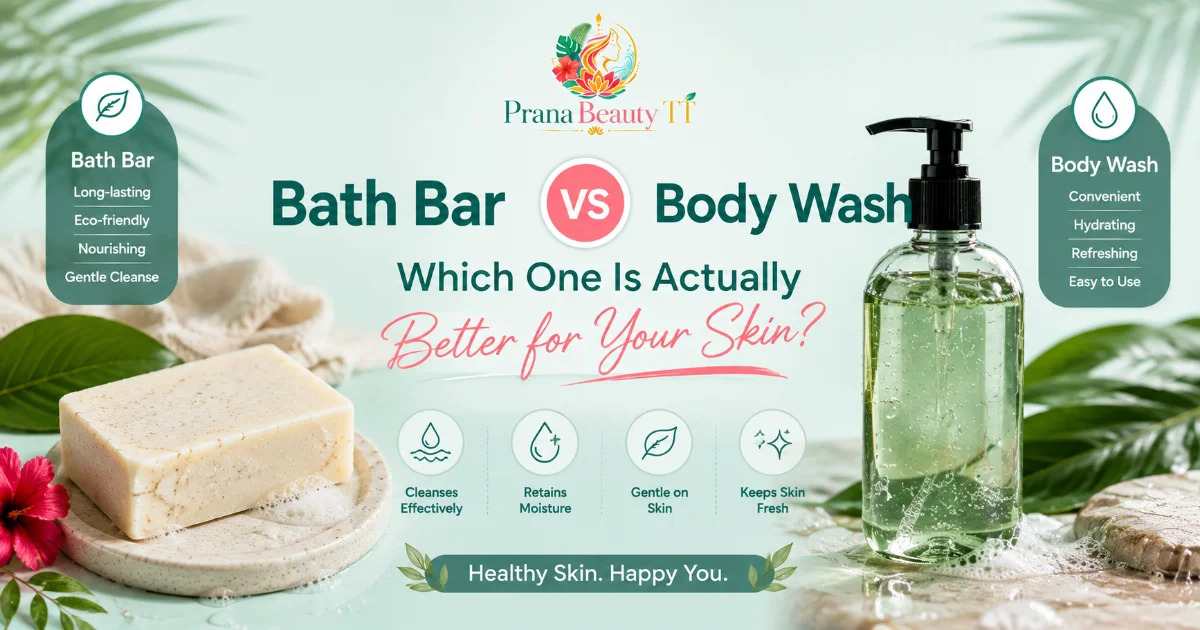
The bath bar vs body wash debate usually gets answered with “it depends on your skin.” That’s true, but it’s not useful. Here’s what actually matters: the cleansing agents inside the product, the pH of the formula, and how your skin responds in Trinidad and Tobago’s tropical heat and humidity.
This guide breaks down what each format does differently, which ingredients to pay attention to, and how to choose based on your specific skin type, not marketing labels.
How Bath Bars and Body Washes Actually Differ
The difference between a bath bar and a body wash goes deeper than solid vs liquid.
Traditional bath bars are made through a chemical process called saponification, where fats and oils react with an alkali (like sodium hydroxide) to create soap. This process is effective at cleansing, but it often produces a product with a higher, more alkaline pH — typically between 9 and 10.
Your skin’s natural pH sits between 4.5 and 5.5. That gap matters. When you regularly wash with a cleanser that’s significantly more alkaline than your skin, it can disrupt the acid mantle — a thin protective layer that helps keep moisture in and bacteria out. Over time, this can contribute to dryness, tightness, and irritation.
Body washes are liquid cleansers that use surfactants to lift oil, sweat, and dirt from the skin. Because they’re water-based, formulators can adjust the pH more easily to match the skin’s natural range. Many body washes also include humectants (like glycerin or hyaluronic acid) and emollients that help maintain moisture during cleansing.
But here’s the part most articles skip: not all bath bars are traditional soap. Syndet bars (short for “synthetic detergent”) are solid cleansers formulated with milder surfactants and a lower pH, closer to the skin’s own level. A well-made syndet bar can be just as gentle as a body wash, sometimes more so than a cheap liquid cleanser loaded with sodium lauryl sulfate.
The bottom line: the format (bar vs liquid) tells you almost nothing about how the product will treat your skin. The surfactant system and pH tell you far more.
Why This Matters More in Trinidad and Tobago?
If you live in Trinidad and Tobago, your cleanser choice carries extra weight because of the climate you’re washing in.
With average humidity often above 80% and temperatures regularly in the low 30s (°C), your skin deals with constant sweat production, increased sebum output, and a higher risk of clogged pores. Many people shower twice a day, morning and evening, to manage the heat.
That frequency changes the equation. A cleanser that feels fine with one use per day can gradually strip too much moisture when used twice daily in hot water. Over weeks, this leads to the “oily but dry” problem: your skin feels greasy on the surface because it’s overproducing oil to compensate for a damaged moisture barrier underneath.
Caribbean humidity also means sweat doesn’t evaporate efficiently, so it sits on the skin longer, mixing with sebum and environmental debris. This makes thorough but gentle cleansing essential, you need a product that actually removes build-up without over-stripping.
For people in Trinidad and Tobago, the practical priorities are: a cleanser that handles sweat and oil effectively, doesn’t dry out the skin with twice-daily use, and rinses cleanly without leaving heavy residue in humid conditions.
Bath Bar vs Body Wash: Choosing by Skin Type
Dry Skin
Dry skin in a tropical climate is more common than people expect. High humidity doesn’t mean your skin is hydrated — heat, sun exposure, air conditioning, and over-cleansing can all pull moisture from the skin barrier.
If your skin feels tight, flaky, or rough after washing, your cleanser is likely part of the problem. The American Academy of Dermatology recommends using gentle cleansers, washing with warm (not hot) water, and moisturising immediately after bathing when dryness is a concern.
For dry skin, look for cleansers, whether bar or liquid, that contain moisturising ingredients like shea butter, olive oil, coconut oil, or glycerin. Avoid anything that leaves a “squeaky clean” feeling, which is actually a sign that too much of the skin’s natural oil has been removed.
Bath bars built around nourishing oils can work well here. Prana Beauty TT’s Rose Pink Clay Bath Bar is formulated with extra virgin coconut oil, raw shea butter, olive oil, and castor oil, all emollient ingredients that help offset the drying effect of cleansing. The pink clay provides gentle exfoliation to clear dull, flaky surface skin without harsh scrubbing.
Oily Skin
Oily skin doesn’t need the harshest cleanser you can find. Over-cleansing triggers a rebound effect where the skin produces even more oil to replace what was stripped away.
In Trinidad’s humidity, oily skin is especially prone to sweat-related breakouts and congested pores. The goal is a cleanser that removes excess surface oil and sweat thoroughly, without leaving the skin feeling tight or raw.
Body washes with gentle surfactants tend to rinse cleanly without heavy residue, which can be an advantage for oily skin. Prana Beauty TT’s Charcoal Body Wash uses activated charcoal to help draw out impurities and absorb excess oil, while the liquid format rinses off easily.
For a bar option, the Charcoal Bath Bar offers similar charcoal-based cleansing in a solid format. Charcoal is an absorbent ingredient — it binds to surface impurities and excess sebum, helping to keep pores clearer.
Combination Skin
Combination skin, oily in some areas, normal or dry in others, is common in tropical climates. The challenge is finding a cleanser that handles the oily zones without punishing the drier areas.
A moderate, well-formulated cleanser usually works better than trying to use different products on different parts of your body. Choose something that cleanses effectively without being overly stripping, and adjust your moisturising routine to address the areas that need it.
Sensitive Skin
Sensitive skin reacts more easily to fragrances, strong surfactants, and certain preservatives. If you frequently experience redness, burning, itching, or stinging after washing, simplify your cleanser.
Look for products with shorter ingredient lists, no added synthetic fragrance, and mild cleansing agents. Both bars and body washes can work for sensitive skin, but the formulation matters more than the format. Ingredient-focused bars made with simple oils and botanical ingredients, without added dyes, fragrances, or harsh surfactants, are worth considering.
What to Look for in Any Cleanser?
Regardless of whether you choose a bath bar or body wash, check these things:
pH level: Closer to 5.5 is generally more compatible with your skin’s natural environment. Research published in the Journal of the American Academy of Dermatology has found that pH plays an important role alongside the surfactant system in determining how mild a cleanser is, for both bars and body washes.
Surfactant type: Harsh surfactants like sodium lauryl sulfate (SLS) can strip the skin aggressively. Gentler alternatives (like sodium cocoyl isethionate, found in many syndet bars) clean effectively with less disruption.
Moisturising ingredients: Oils (coconut, olive, castor), butters (shea, cocoa), and humectants (glycerin, aloe) help counteract the drying effect of cleansing.
Fragrance: Not automatically bad, but if your skin is reactive, fragrance-free or naturally scented formulas may be safer. Products that use only the natural scent of their oils, rather than added synthetic fragrance — tend to be better tolerated.
How your skin feels 30 minutes after washing: This is the most practical test. If your skin feels comfortable and balanced, the cleanser is working. If it feels tight, dry, itchy, or irritated, something in the formula isn’t right for you — regardless of how “natural” or “gentle” the label claims.
Bath Bar vs Body Wash: Quick Comparison
| Factor | Bath Bar | Body Wash |
|---|---|---|
| Cleansing ability | Equally effective when properly formulated | Equally effective when properly formulated |
| pH range | Traditional soap: 9–10 (alkaline); syndet bars: can be lower | Typically easier to formulate at skin-friendly pH (5–6) |
| Moisturising potential | Depends on formula — oil-rich bars can be very moisturising | Often contains added humectants and emollients |
| Best for oily skin | Charcoal or clay-based bars absorb excess oil well | Rinses cleanly, less residue in humid conditions |
| Best for dry skin | Oil-rich, cold-processed bars with shea/coconut/olive oil | Cream-based washes with glycerin or hyaluronic acid |
| Convenience | Compact, no bottle needed, easy to travel with | Easy to dispense a specific amount, no shared-surface concern |
| Cost per use | Generally lasts longer per unit of product | Typically more product used per wash |
| Environmental footprint | Minimal packaging, no plastic bottle | Usually comes in plastic packaging |
| Shelf life in humidity | Let it dry between uses to prevent softening | No special storage needed |
Prana Beauty TT Options: What Fits Where
Prana Beauty TT carries both bath bars and body washes, so you can choose based on your skin’s actual needs rather than being limited to one format.
Bath bars for targeted skin concerns: The Rose Pink Clay Bath Bar combines pink clay (a gentle absorbent and exfoliant), rose hydrosol, coconut oil, shea butter, olive oil, and castor oil. It’s formulated without added synthetic fragrance, sulphates, parabens, or artificial colours. This makes it a practical option for anyone who wants gentle exfoliation and nourishing oils in a solid format.
Body washes for clean-rinsing convenience: The Charcoal Body Wash, Orange Body Wash, and Wild Berry Body Wash offer liquid cleansing options with different scent profiles. For oily or acne-prone skin, the charcoal variant provides oil-absorbing cleansing in a liquid format that rinses without residue.
If your skin does well with a bar, use a bar. If you prefer the convenience and clean rinse of a liquid, use a body wash. The product that keeps your skin clean, comfortable, and balanced after every wash is the right one.
How to Get the Most from Your Cleanser in a Tropical Climate
A few practical habits make a real difference when you’re showering once or twice a day in Trinidad’s heat:
Use warm water, not hot. Hot water feels good but strips more natural oils from your skin. Warm water cleanses just as effectively without the moisture loss — which matters more when you’re washing twice a day.
Let bath bars dry between uses. In high humidity, a bar that sits in water will soften and dissolve faster. Use a draining soap dish or store it out of the direct water stream.
Moisturise while your skin is still slightly damp. Applying a body lotion or butter within a few minutes of drying off helps seal in moisture before the air pulls it away. This is especially important in air-conditioned spaces, which can dry the skin further.
Don’t over-cleanse. If you shower twice a day, you don’t necessarily need to use a full lather of cleanser both times. A quick water rinse for the second shower, with cleanser only where you need it (underarms, groin, feet), can reduce the drying effect of double-cleansing.
Frequently Asked Questions
Does body wash clean better than a bath bar?
No. Both formats effectively remove sweat, oil, and dirt when the product is well-formulated. The cleansing agents inside the product — not whether it’s solid or liquid — determine how well it cleans.
Is a bath bar more drying than body wash?
Traditional alkaline soap bars can be more drying than pH-balanced liquid cleansers. But bars made with nourishing oils and gentler cleansing agents — like cold-processed bars with shea butter, coconut oil, and no sulphates — can be just as mild as a body wash.
Can I use a bath bar on my face?
Some bath bars are gentle enough for facial use, but your face often has different needs than body skin. If you have sensitive, acne-prone, or very dry facial skin, a dedicated facial cleanser is usually a better choice.
How do I know if my cleanser is too harsh?
Watch for persistent tightness, flaking, redness, itching, or a burning sensation after washing. These are signs the cleanser is disrupting your skin barrier. If the problem continues after a week or two, switch products.
Should I switch cleansers with the seasons?
In Trinidad and Tobago, the climate is consistently warm and humid, so seasonal switching is less relevant than it would be in a temperate climate. However, if you notice your skin getting drier during certain months (especially if you spend more time in air conditioning), you might benefit from switching to a more moisturising formula temporarily.
Can I use both a bath bar and body wash?
Yes. Some people use a bath bar at home and a body wash when travelling, or use a body wash for quick showers and a bath bar for longer, more thorough washes. There’s no rule against alternating.
The Bottom Line
The bath bar vs body wash question has a simpler answer than most articles make it: the format doesn’t matter nearly as much as the formula. A bath bar rich in nourishing oils and free from harsh surfactants can be gentler than a cheap body wash loaded with SLS. A well-formulated body wash can be more moisturising than a traditional alkaline soap bar.
In Trinidad and Tobago’s climate, where you’re likely washing more often and dealing with constant heat and humidity, the priority is a cleanser that handles sweat and oil without weakening your skin’s moisture barrier over repeated use.
Choose based on your skin type, your cleansing needs, and how the product actually makes your skin feel, not based on whether it comes in a bar or a bottle.