
Castor oil has become one of the most hyped ingredients in natural beauty. Social media claims range from “miracle hair growth oil” to “cure for baldness,” and most articles either oversell it or dismiss it entirely.
The truth sits in the middle, and it matters where you live. If you’re in Trinidad and Tobago, the way you use castor oil needs to account for humidity, heat, and how thick oils behave on your scalp in tropical conditions. Get it wrong and you’re feeding the exact scalp problems you’re trying to fix.
Here’s what the research actually supports, what it doesn’t, and how to use castor oil properly in this climate.
What Makes Castor Oil Different from Other Oils?
Castor oil is extracted from the seeds of the Ricinus communis plant. What sets it apart from coconut, argan, or jojoba oil is its fatty acid profile: roughly 90% of castor oil is ricinoleic acid, a compound rarely found in other plant oils.
Ricinoleic acid gives castor oil two distinctive properties. First, it’s unusually thick and viscous, which allows it to coat hair strands and lock in moisture more effectively than thinner oils. Second, it has documented anti-inflammatory and mild antimicrobial activity, which makes it relevant for scalp health.
A 2026 narrative review published in Cureus examined castor oil’s dermatological applications across multiple studies. The review found evidence supporting its use for improving hair luster, enhancing skin hydration and elasticity, reducing hyperpigmentation, and increasing the penetration of other active ingredients when used in formulations.
That’s a useful ingredient. It’s not a miracle.
Does Castor Oil Actually Grow Hair?
This is the most common claim, and the most overstated.
No large-scale clinical trial has proven that castor oil makes hair grow faster or thicker. A systematic review published in the Journal of Drugs in Dermatology examined coconut, castor, and argan oil for hair health and concluded there is “weaker evidence for castor oil improving hair quality by increasing hair luster, and no strong evidence supporting its use for hair growth.”
What the evidence does support is that castor oil protects the hair you already have. By coating the hair shaft with a thick layer of ricinoleic acid, it reduces protein loss, prevents moisture evaporation, and decreases friction between strands. The result is less breakage, more retained length, and shinier hair over time.
There is one mechanism that suggests a potential growth benefit: ricinoleic acid may inhibit prostaglandin D2 synthesis, a compound associated with hair follicle miniaturisation in androgenic alopecia. The Cureus review noted this pathway, but emphasised that clinical investigation is still needed to confirm it.
The honest takeaway: castor oil is a proven hair protector and conditioner. Calling it a hair growth oil is getting ahead of the science. Where it genuinely helps growth is as one ingredient in a multi-oil blend, not used alone.
What Castor Oil Does for Your Scalp?
This is where castor oil earns its place, especially in a tropical climate.
Ricinoleic acid’s anti-inflammatory properties can help calm an irritated, overworked scalp. In Trinidad, where your scalp deals with constant sweat, humidity, and sebum production, inflammation is common. A scalp that’s chronically inflamed doesn’t support healthy hair growth regardless of what oils or treatments you apply.
Castor oil also creates a protective barrier on the scalp surface that helps retain moisture without the lightweight feel of thinner oils. For people with dry, flaky scalps, this barrier function can reduce irritation and flaking.
However, this same thickness becomes a liability if overused. In humid conditions, leaving heavy castor oil on your scalp for extended periods mixes with sweat and sebum, creating build-up that clogs follicles and can worsen dandruff. The application method matters as much as the ingredient itself.
What Castor Oil Does for Skin?
Beyond hair, castor oil has documented skin benefits that the Cureus review confirmed across multiple studies.
Hydration and barrier repair. Ricinoleic acid acts as a humectant, drawing moisture to the skin and preventing transepidermal water loss. In Trinidad’s humidity, your skin doesn’t lack ambient moisture, but air conditioning, sun exposure, and frequent washing can still compromise the skin barrier. Castor oil helps seal that barrier.
Hyperpigmentation. The review found evidence that castor oil can reduce hyperpigmentation through its antioxidant properties. For skin that deals with constant UV-driven melanin production (as in Trinidad, where the UV index regularly exceeds 12), this is a relevant benefit when used alongside sun protection.
Scar and stretch mark appearance. Regular application improves blood flow to the area and supports tissue regeneration, which can gradually improve the appearance of scars and stretch marks over time.
How to Use Castor Oil Properly in Tropical Heat?
This section exists because most castor oil advice ignores climate. Applying castor oil the same way in Trinidad as someone in London will produce different results, and not always good ones.
Never use pure castor oil undiluted on your hair. Castor oil’s extreme viscosity creates a serious, documented risk: acute hair felting. This is a condition where hair fibres mat into a dense, tangled mass that cannot be detangled and has to be cut off. Published case reports in the International Journal of Trichology have traced it directly to heavy castor oil application. The risk increases with undiluted use, large amounts, and overnight application.
This is why blended formulations are safer and more effective than straight castor oil. When castor oil is combined with lighter carrier oils at controlled ratios, the viscosity drops to a workable level while retaining the ricinoleic acid benefits.
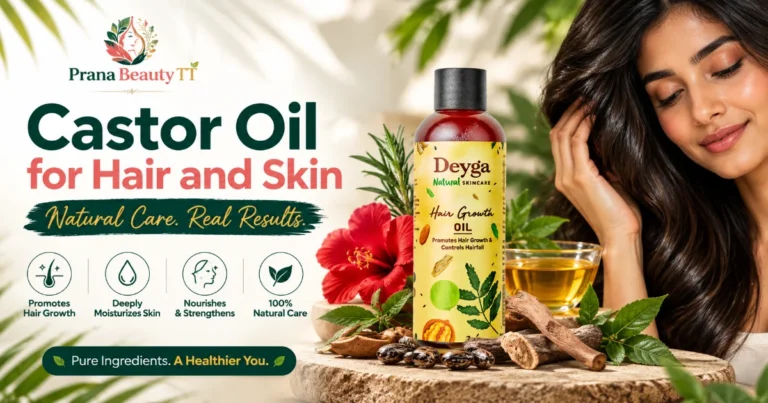
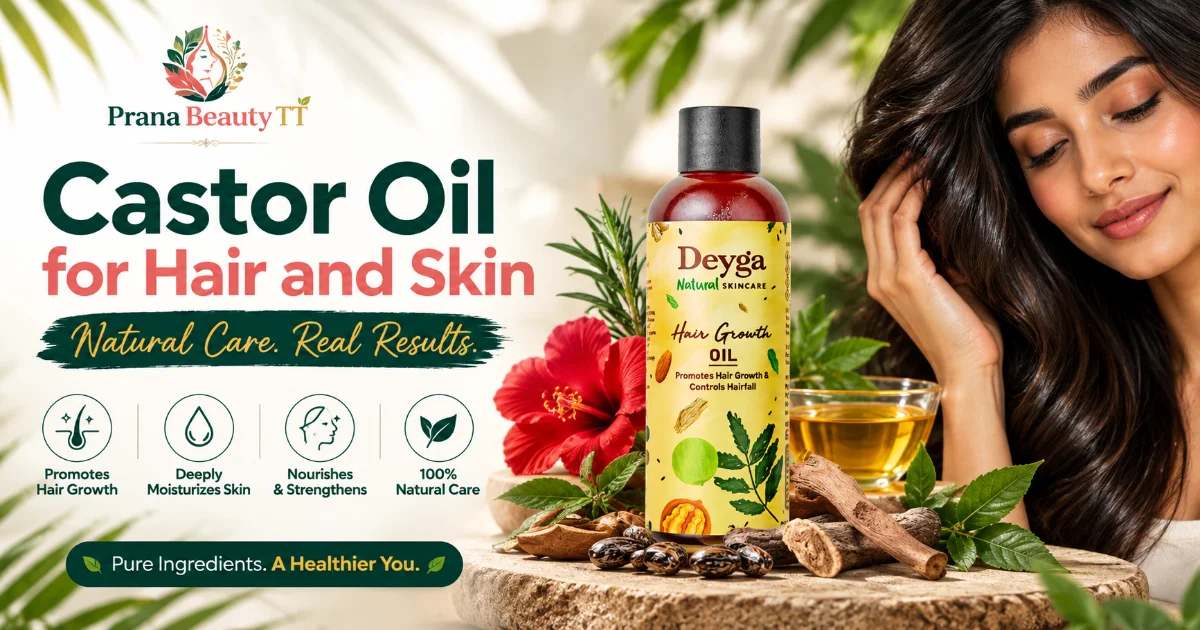
For scalp and hair treatment: Prana Beauty TT’s Hair Growth Oil blends castor oil with coconut oil, grapeseed oil, rosemary, bhringraj, fenugreek, and curry leaves. This formulation delivers castor oil’s benefits within a balanced blend that spreads evenly, absorbs properly, and washes out cleanly. Apply to the scalp, massage for 5-10 minutes, leave for 1-2 hours, and wash out thoroughly. In Trinidad’s heat, avoid overnight application unless your scalp tolerates it well.
For eyebrow growth: Castor oil has been traditionally used for eyebrow thickening, and while clinical evidence is limited, the protective coating it provides can reduce breakage of eyebrow hairs from rubbing and environmental exposure. Prana Beauty TT’s Eyebrow Growth Oil combines castor oil with argan, coconut, rosemary, lavender, tea tree, and Vitamin E oils for a targeted eyebrow treatment. Apply a small amount with a clean brush before bed.
For premature greying: Oxidative stress is a contributing factor to premature greying, and castor oil’s antioxidant properties may help support melanocyte function over time. Prana Beauty TT’s Premature Greying Oil uses castor oil alongside benne oil, coconut oil, bhringraj, henna, and moringa in a formulation targeting this concern.
For skin: Apply a thin layer to clean, slightly damp skin. In humid conditions, you don’t need much. A few drops patted into dry patches, scars, or stretch marks is sufficient. Avoid applying to oily or acne-prone areas of the face, as the thickness can clog pores.
Which Hair Types Benefit Most?
Castor oil works best on thick, coarse, or textured hair that loses moisture easily. Curly and coily hair types, common across Trinidad and Tobago’s diverse population, have a raised cuticle structure that allows moisture to escape faster. Castor oil’s heavy coating seals the cuticle and locks hydration in along the full strand length.
For fine or thin hair, pure castor oil is usually too heavy. It weighs strands down, creates a greasy appearance, and is difficult to wash out completely. If you have fine hair, use castor oil only as part of a blended formula (like the Hair Growth Oil) and apply to the scalp rather than coating the lengths.
Frequently Asked Questions
How often should I use castor oil on my hair?
Once or twice a week as a pre-wash treatment. More frequent use in tropical heat risks scalp build-up and follicle congestion. Always wash it out thoroughly.
Can castor oil worsen dandruff?
Yes, if used incorrectly. Leaving heavy castor oil on your scalp in humid conditions feeds the Malassezia fungus that causes dandruff. Use it as a wash-out treatment, not a leave-in, and if you have active dandruff, treat that first before adding castor oil to your routine.
Is Jamaican black castor oil better than regular castor oil?
Jamaican black castor oil is produced by roasting the beans before extraction, which gives it a darker colour and ash content. There is no clinical evidence that it performs better than cold-pressed castor oil for hair or skin. Choose based on personal preference.
The Bottom Line
Castor oil is a genuinely useful ingredient for hair protection, scalp health, and skin hydration. It reduces breakage, adds luster, calms inflammation, and supports the skin barrier. What it isn’t is a proven hair growth accelerator, despite what social media suggests.
In Trinidad’s climate, how you use it matters more than whether you use it. Keep it in a blended formula, apply it as a pre-wash treatment, wash it out completely, and don’t leave thick oil sitting on your scalp in tropical heat. Used correctly, it’s one of the most effective natural oils available. Used carelessly, it creates the build-up and scalp problems you’re trying to solve.