
Curly hair in Trinidad and Tobago faces a problem that most hair care content ignores: year-round, unrelenting humidity above 80%. Articles written for temperate climates treat frizz as a seasonal annoyance. Here, it’s the default state of your hair from January to December.
Trinidad also has one of the most diverse populations in the Caribbean, with hair textures ranging from loose waves to tight coils, and everything in between. A single curly hair guide can’t treat all these textures identically, but the underlying science of how humidity interacts with curled hair applies across the spectrum.
This guide covers what’s actually happening to your curls in this climate, which factors matter more than curl pattern, and how to build a routine that keeps curls defined and manageable in tropical conditions.
Why Curly Hair Reacts to Humidity More Than Straight Hair?
The difference comes down to structure. Curly and coily hair has a naturally more raised cuticle than straight hair. The cuticle is the outermost layer of each strand, made up of overlapping scales that function like roof shingles. When these scales lie flat, hair looks smooth and shiny. When they’re raised, hair absorbs moisture from the environment uncontrollably.
In humid air, water molecules bond to the keratin proteins inside the hair shaft through hydrogen bonds. This causes the strand to swell unevenly along its bends and twists. The result is what you see as frizz: individual strands separating from their curl clumps, volume increasing in the wrong places, and defined curls loosening into a shapeless puff.
Straight hair resists this because its flatter cuticle creates a tighter barrier against ambient moisture. Curly hair, with its raised cuticle and irregular surface, absorbs humidity almost like a sponge. In Trinidad, where the air is saturated with moisture year-round, this absorption happens within minutes of stepping outside.
Porosity Matters More Than Curl Pattern
Most curly hair advice focuses on curl type (2A, 3B, 4C, and so on). In a tropical climate, porosity is the more useful framework.
Porosity describes how easily your hair absorbs and retains moisture. It’s determined by the condition of your cuticle layer.
Low porosity hair has a tightly sealed cuticle. It resists absorbing moisture, which sounds like an advantage in humidity. The trade-off is that products sit on the surface rather than penetrating, and when low porosity hair does absorb excess moisture, it’s slow to release it. Lightweight, water-based products work best. Heavy oils and butters tend to create build-up.
High porosity hair has a raised, damaged, or naturally open cuticle. It absorbs moisture rapidly but loses it just as fast. In Trinidad’s humidity, high porosity curls absorb ambient moisture quickly, swell, frizz, and then dry out again as the moisture escapes. This constant swelling and contracting is called hygral fatigue, and over time it weakens the hair shaft and increases breakage. Sealing products and protein treatments help reinforce the cuticle and slow this cycle.
The practical test: After washing, observe how long your hair takes to air dry. Slow drying (several hours) suggests low porosity. Fast drying (under an hour) suggests high porosity. Average drying time suggests medium porosity.
Knowing your porosity tells you whether your curls need help absorbing moisture (low porosity) or retaining it (high porosity). In Trinidad’s climate, high porosity hair needs the most intervention because humidity constantly disrupts its already-compromised cuticle.
A Curly Hair Routine Built for Tropical Humidity
The goal in this climate is to hydrate curls on your terms, then seal the cuticle to prevent ambient humidity from overriding your efforts.
Cleanse: Gentle, Sulphate-Free
Curly hair is naturally drier than straight hair because sebum from the scalp travels down straight strands easily but struggles to navigate the bends and spirals of curled hair. Harsh sulphate shampoos strip what little natural oil reaches the lengths, leaving curls dry and more porous.
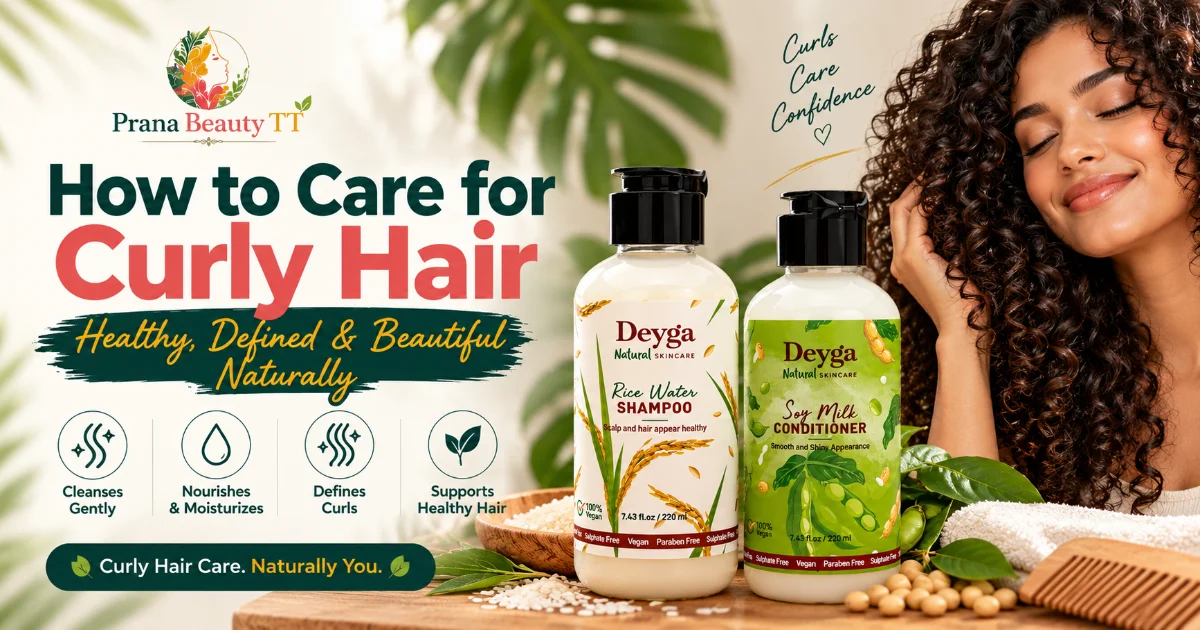
Prana Beauty TT’s Rice Water Shampoo is sulphate-free, which makes it safe for frequent use without triggering the rebound oiliness cycle. The inositol in fermented rice water penetrates damaged areas of the hair shaft and reduces surface friction, which directly helps with detangling curly hair after washing.
For a bar alternative, the Coconut Milk Shampoo Bar combines coconut milk’s fatty acids with amla and shikakai for gentle cleansing. Apply to the scalp only and let suds travel down the lengths.
Condition: Mid-Length to Ends, Every Wash
Conditioner is not optional for curly hair. It closes the cuticle after cleansing, adds slip for detangling, and provides the moisture that curly strands can’t get from scalp oils alone.
Prana Beauty TT’s Soy Milk Conditioner is lightweight enough for Trinidad’s humidity while still delivering soy protein and hydration. Heavy conditioners can weigh curls down and attract even more moisture from humid air, so a lighter formula works better here than a thick, cream-based product.
Apply from mid-length to ends. Detangle with a wide-tooth comb or your fingers while the conditioner is in. Rinse with cool water to help flatten the cuticle before you step into humid air.
Seal: Lock the Cuticle with a Serum
This step separates functional curly hair care from wishful thinking in a tropical climate. Without a sealing layer, everything you did in the shower gets undone the moment humidity hits your hair.
Prana Beauty TT’s Hair Serum (Liquid Gold) creates a lightweight barrier on the hair shaft that reduces how much ambient moisture can penetrate and swell the cuticle. Apply 2-3 drops to damp hair, scrunching upward to encourage curl formation rather than pulling strands straight.
For high porosity hair, this sealing step is critical. The serum fills gaps in the raised cuticle, slowing the moisture-in/moisture-out cycle that causes hygral fatigue and progressive damage.
Pre-Wash Oil Treatment: Weekly
Curly and coily hair benefits from a weekly oil treatment applied 1-2 hours before washing. This pre-coats the hair shaft with a protective layer that prevents the shampoo from stripping too aggressively.
Prana Beauty TT’s Hair Growth Oil combines coconut oil (proven to reduce protein loss in hair), castor oil, rosemary, and bhringraj. Massage into the scalp for circulation and apply lightly through the lengths. Wash out thoroughly on your next wash day.
Mistakes That Ruin Curls in Humid Conditions
Towel-drying aggressively. Regular cotton towels create friction that lifts the cuticle and separates curl clumps. Blot with a microfibre towel or an old cotton t-shirt instead. The gentler you are at this stage, the less frizz you’ll deal with later.
Skipping the sealing step. Washing and conditioning without sealing is like painting a wall without primer in rainy weather. The moisture you put in gets replaced by ambient moisture within the hour, and you lose curl definition.
Using products that are too heavy. Thick butters, heavy creams, and layering multiple leave-in products create build-up that weighs curls down and attracts more humidity. In Trinidad’s climate, lighter formulations outperform heavy ones for most curl types.
Touching curls while drying. Every touch separates strands from their curl clumps. Let curls air dry completely (or diffuse on low heat) before touching. If you must style, scrunch upward rather than pulling downward.
Over-washing. Curly hair rarely needs daily washing. 2-3 times per week is sufficient for most people. On non-wash days, refresh curls with a light mist of water and a small amount of serum rather than re-washing.
Frequently Asked Questions
How do I sleep without ruining my curls in the humidity?
Use a satin or silk pillowcase, or wrap hair loosely in a satin bonnet. Cotton pillowcases absorb moisture from your hair and create friction that disrupts curl patterns overnight. In Trinidad’s warm nights, a loose pineapple (gathering curls in a high, loose ponytail) with a satin scrunchie keeps curls together without creating heat build-up on your scalp.
Should I use protein treatments or moisture treatments?
This depends on your porosity. High porosity hair needs both: protein treatments to fill cuticle gaps and strengthen the shaft, followed by moisture to hydrate. Low porosity hair usually needs moisture more than protein, as excess protein can make low porosity curls stiff and brittle. Alternate between protein and moisture based on how your hair feels. If curls feel mushy and limp, they need protein. If they feel dry and crunchy, they need moisture.
Can I straighten my curly hair and switch back without damage?
Heat straightening temporarily breaks the hydrogen bonds that form your curl pattern. Occasional use with a heat protectant causes minimal permanent damage. Frequent straightening, especially at high temperatures, can cause cumulative damage that alters curl pattern and increases porosity. If you straighten regularly, balance it with protein treatments and deep conditioning to maintain strand integrity.
The Bottom Line
Curly hair care in Trinidad requires accepting one reality: you cannot prevent humidity from interacting with your hair. You can only control how that interaction plays out.
A routine built around gentle sulphate-free cleansing, lightweight conditioning, and consistent sealing gives your curls the best chance of staying defined in 80%+ humidity. Know your porosity, choose products that match it, seal after every wash, and stop fighting the climate with heavy products that create build-up.
Your curls aren’t the problem. The approach is.