
Quick answer: Stretch marks are a type of scar that forms when skin stretches faster than it can adapt, during puberty, pregnancy, weight changes or muscle growth. They’re harmless and very common. They usually fade over time but rarely disappear completely. New, red or dark marks respond best to treatment. Mayo Clinic notes that creams with cocoa butter or vitamin E aren’t harmful but probably won’t help much, and a Cochrane review found no strong evidence that creams prevent stretch marks in pregnancy. Moisturising keeps the skin comfortable and less itchy. For visible change, a dermatologist can offer prescription creams or procedures, chosen carefully for darker skin.
Stretch marks show up on most people at some point: on teenagers after a growth spurt, on mothers after pregnancy, on gym-goers who build muscle fast. Yet the internet is full of products and home remedies promising to “erase” them in weeks.
This guide sets out what the research actually shows, so you can spend your money and effort on what helps.
What Are Stretch Marks?
Stretch marks (the medical term is striae distensae) form when the middle layer of the skin, the dermis, is stretched quickly. The collagen and elastin fibres that keep skin firm break down, and the skin repairs itself with a line of scar-like tissue.
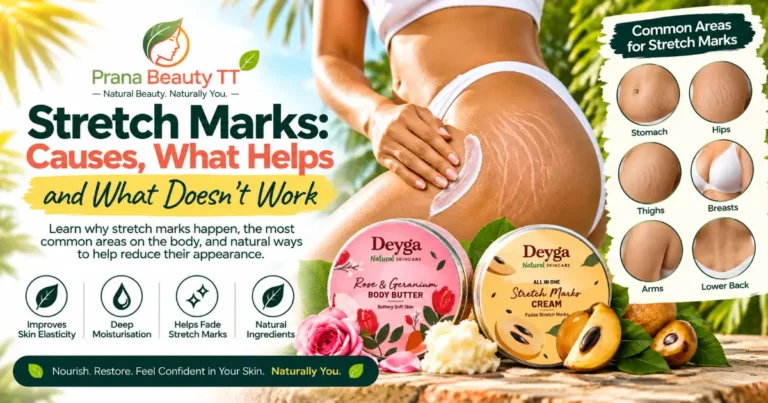
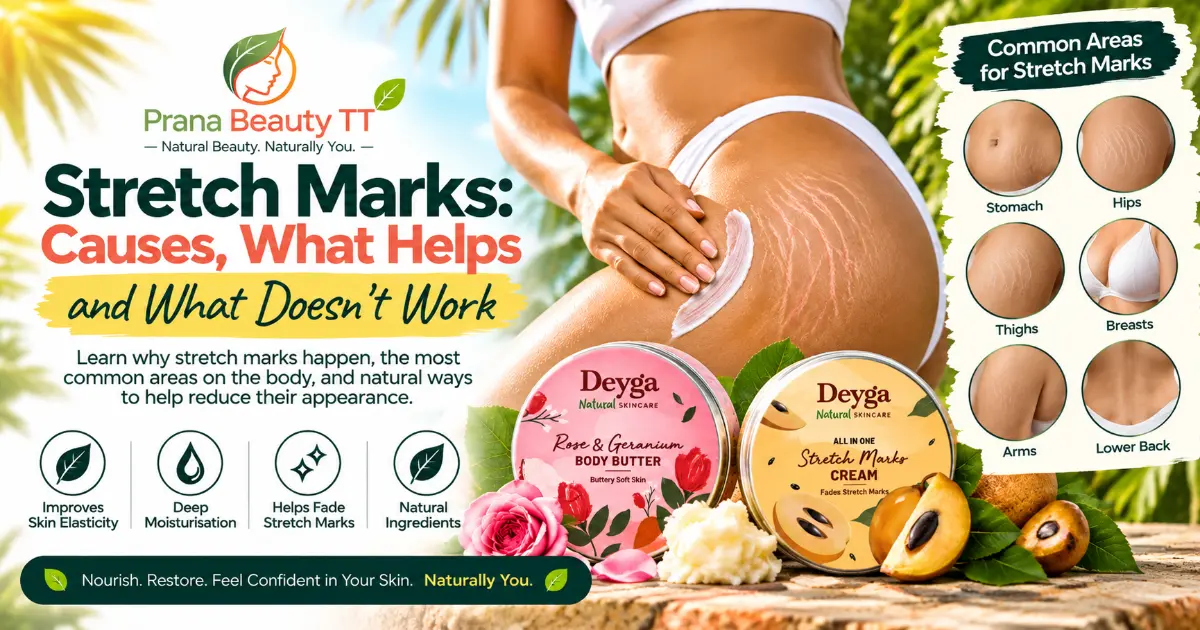
They often appear on the stomach, hips, thighs, buttocks, breasts, upper arms and lower back.
What Do Stretch Marks Look Like on Different Skin Tones?
| Stage | Lighter skin | Medium to deep skin (common in Trinidad) |
| New (early) | Pink, red or purple; may feel raised and itchy | Often reddish-brown or dark brown, darker than the surrounding skin |
| Old (mature) | White or silvery, slightly sunken | Paler than the surrounding skin or close to skin colour, slightly sunken |
New marks are called striae rubrae. Old, faded ones are striae albae. On darker skin, early marks can be very dark, a type sometimes called striae nigrae. Texture is often a better guide than colour: new marks may feel slightly raised, while old ones feel slightly indented.
This matters because new marks respond to treatment much better than old ones.
What Causes Stretch Marks?
- Puberty: fast growth in height, hips, breasts or thighs.
- Pregnancy: the belly, breasts and hips stretch quickly, usually in the later months.
- Weight gain or loss, especially when it’s fast.
- Building muscle quickly, often on the shoulders and upper arms.
- Family history: if your mother had them, you’re more likely to get them.
- Steroid medicines and some medical conditions: long-term steroid creams or tablets, and hormone disorders such as Cushing’s syndrome.
Do Stretch Mark Creams Work?
This is the question most people really want answered. Here’s what the evidence says:
| Option | What the evidence shows |
| Cocoa butter, vitamin E, olive oil | Mayo Clinic says these aren’t harmful but “probably won’t help much.” |
| Creams to prevent stretch marks in pregnancy | A Cochrane review of topical treatments found no high-quality evidence that they prevent stretch marks. |
| Moisturising and massage | May keep skin soft and ease itching. Any benefit for the marks themselves is likely from moisture and massage, not a special ingredient. |
| Prescription tretinoin (retinoid) | May improve new marks less than a few months old; it can irritate skin and must not be used in pregnancy. |
| Microneedling, lasers, light therapy | Can improve appearance over several sessions; results vary and the marks rarely disappear. |
| Self-tanner or makeup | Doesn’t treat marks but can make them less noticeable. |
So is a stretch marks cream worth using?
Yes, if you understand what it can and can’t do. A good cream keeps the skin hydrated, soft and less itchy, which matters a lot during pregnancy and growth spurts, when stretching skin often feels tight and itchy. Applying it daily with massage also makes it easy to notice new marks early, when they respond best to treatment.
What a cream can’t do is remove a stretch mark. Any product claiming to “erase” old, white stretch marks is overpromising.
The Stretch Marks Cream is made for daily use on stretching skin. For extra moisture at night, you can follow with a richer body butter such as the Rose & Geranium Body Butter.
How to Care for Stretch Marks Day to Day
- Moisturise once or twice a day, massaging the cream in gently for a minute or two over the areas that are stretching.
- Apply to damp skin after a shower to lock in more water. Our guide to soft, smooth skin in Trinidad explains the routine.
- Ease itching without scratching. A cool, light gel such as aloe vera can soothe itchy, stretching skin. Scratching irritates the skin and can leave dark marks on deeper skin tones.
- Protect the area from the sun. In Trinidad’s strong sun, keep marks covered or use sunscreen on exposed areas, so the skin around them doesn’t darken and make them stand out more.
- Aim for steady weight changes where you can, rather than very fast gain or loss.
- Be patient. Many stretch marks fade noticeably on their own over 6 to 12 months.
Stretch Marks on Darker Skin: Treatment Cautions
Most people in Trinidad and Tobago have medium to deep skin tones, and that changes which treatments are safest.
- Lasers and light treatments carry a higher risk of leaving dark patches (post-inflammatory hyperpigmentation) or light patches on darker skin. Intense pulsed light (IPL) is usually a poor choice.
- Microneedling is often preferred for darker skin. Mayo Clinic notes it carries less risk of colour changes than laser therapy.
- Tretinoin can irritate the skin, and irritation can itself cause dark patches. Dermatologists often start with a few nights a week.
- Ask for a test patch before treating a large area, and check it after several weeks.
Fading the dark colour of new marks is similar to fading other dark marks. See our guide to how to fade dark spots and uneven skin tone.
When to See a Doctor
Stretch marks are usually harmless, but see a doctor if:
- They appear suddenly and widely without an obvious reason like pregnancy, a growth spurt or weight change
- They come with other changes such as weight gain around the face and belly, easy bruising or muscle weakness, which can point to a hormone problem
- You’ve been using a steroid cream on the same area for a long time
- You want medical treatment to reduce their appearance
Frequently Asked Questions
Can men get stretch marks?
Yes. Men often get them during teenage growth spurts, with weight changes, or on the shoulders, chest and arms from fast muscle gain at the gym. The same care and treatment options apply.
Is it safe to use stretch mark cream during pregnancy?
Most simple moisturisers are fine, but check the ingredients with your doctor or midwife. Avoid anything containing retinoids (such as tretinoin or retinol) during pregnancy and breastfeeding unless your doctor approves.
Will losing weight make my stretch marks go away?
No. Stretch marks don’t disappear with weight loss, though they may fade over time. Losing weight very fast can actually cause new ones.
Why are my stretch marks itchy?
New stretch marks often itch because the skin is stretching and slightly inflamed. Keeping the skin moisturised and cool helps. If the itching is intense, or there’s a rash during pregnancy, tell your doctor, as some pregnancy skin conditions need treatment.
Are stretch marks on teenagers normal?
Very. Fast growth during puberty commonly causes stretch marks on the hips, thighs, breasts, back and knees in both girls and boys. They’re not a sign of being overweight, and they usually fade over the following years. A gentle moisturiser can ease any itching.
Final Word
Stretch marks are a normal part of growing, having children and changing shape. They fade with time, and new ones respond best to care. A daily moisturiser like the Stretch Marks Cream keeps stretching skin soft, comfortable and less itchy. For visible change in older marks, talk to a dermatologist, especially about which treatments are safest for your skin tone.